

The recent report from the Institute for Biodiversity and Freshwater Conservation at UHI Inverness prepared on behalf of the River Carron Conservation Association (RCCA) is being widely promoted as a ‘game changer’ for salmon hatcheries. But the claims being made for it go well beyond what the study itself shows. The report does not provide a scientific basis for a general return to salmon hatcheries.
The Carron research report itself is quite cautious. The problem is what happens to its findings when they are translated into publicity and media headlines. Many of the claims now being made represent a substantial overreach from what the study actually demonstrates, with some involving a logical leap from showing that hatchery fish can survive and return as adults to claiming that stocking has restored the wild salmon population, or even that it challenges established evidence on impact of releasing hatchery fish. Those conclusions are not supported by the research itself.
The River Carron salmon population is currently classified as being in Poor conservation status. That alone should caution against presenting more than 30 years of stocking as evidence of successful recovery. Stocking may not only have failed to resolve the decline – at the intensity and duration used on the Carron, it may itself be one of the pressures affecting the wild salmon population.

There are no shortcuts in salmon conservation – the underlying causes of decline have to be addressed. In the Carron, one of the most important unresolved pressures is likely to be the impact of salmon farming in Loch Carron and the wider west-coast marine environment.
The study found that 40% of the smolts sampled during the 2016-2018 migrations, and 46.6% of rod-caught adults sampled between 2017 and 2020, had originated from the stocking programme. The important limitation is that these are proportions in two different samples – not marine survival rates from matched cohorts. The complete smolt runs were not sampled and the researchers therefore did not statistically demonstrate equivalent survival of stocked and wild-spawned fish
The report is being promoted as resolving a “persistent doubt” over whether hatchery reared salmon can survive migration to sea and return as successfully as wild salmon. However, the ability of hatchery salmon to survive and return has been demonstrated for decades, and the Carron report itself describes its result as “not unexpected”.
There is extensive evidence to show that hatcheries can have a negative and counterproductive impact. A global synthesis of 206 peer-reviewed studies found only 3% reported a beneficial effect of hatchery salmonids on wild salmonids. Hatchery fish can compete with naturally produced juveniles, have lower reproductive success, and alter the genetic structure and effective population size of wild populations. Stocking does not remove the underlying causes of decline and may add ecological and genetic pressures of its own.
The Carron study does not demonstrate that the marine survival of hatchery fish was statistically equivalent to that of wild-spawned salmon. It does not show that stocking increased the total number of smolts or adults above what would otherwise have been produced. Nor does it show that wild juveniles were not displaced, that effective population size or genetic integrity improved, or that the population is now self-sustaining without continued hatchery support.
There is therefore a considerable gap between the report and some of the publicity surrounding it. The RCCA has stated that the stocked fish returned at rates “matching wild-spawned fish”, that an outstanding question about stocking has been resolved, and that the result is a “game changer”. Yet the report itself states that no statistical comparison was undertaken, that the complete smolt run was not sampled, and that differences in migration timing could bias the comparison. No outstanding question about stocking was resolved.
The authors themselves explicitly warn that the successful return of hatchery fish does not necessarily mean that stocking has improved the overall status of the population. They discuss lower population productivity, poorer reproductive performance and reduced genetic size as potential consequences, and state that these risks must be considered in any salmon stocking programme.
Presenting this report as proof that decades of hatchery research were wrong is therefore very misleading.
The River Carron salmon population faces substantial pressures from poor marine survival and changing ocean conditions, sea lice associated with salmon farms in Loch Carron and the wider west-coast marine environment, genetic introgression from escaped farm salmon, and freshwater habitat and hydrological pressures including severe spates, unstable spawning gravels and local flow alteration. The Carron fish themselves already contain measurable Norwegian aquaculture ancestry, around 4.5-4.8% on average in the groups analysed.
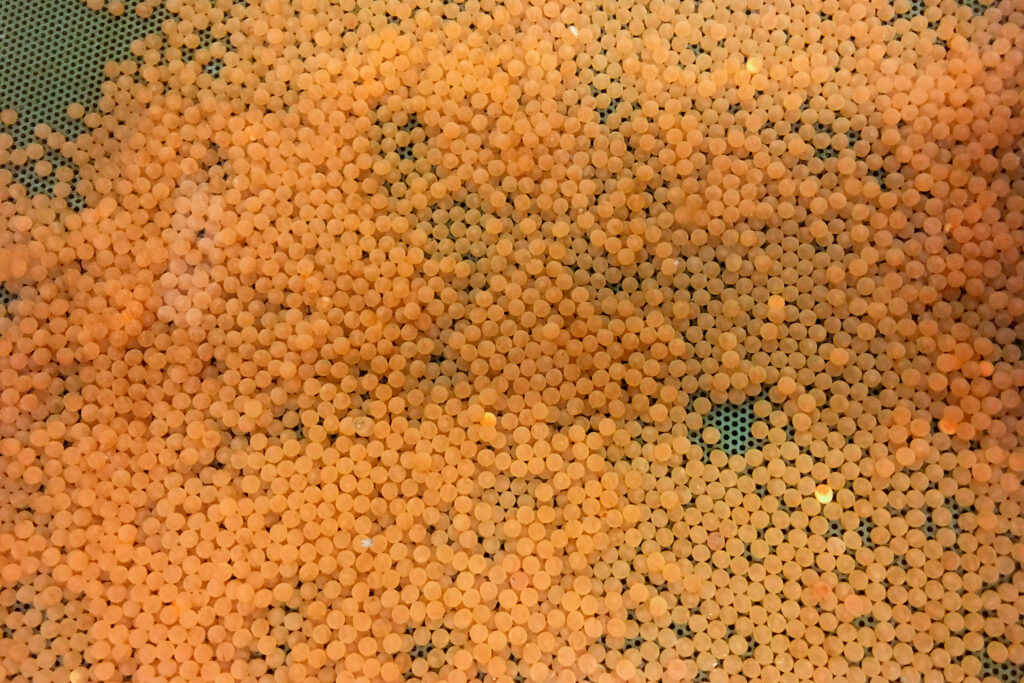
But there is an uncomfortable additional question. After more than 30 years of intensive stocking, with hatchery-origin fish now forming a large component of the population, it is entirely legitimate to ask whether the stocking programme itself has become one of the pressures on the remaining wild salmon population.
Stocking is not simply a response to pressures. At the intensity and duration used on the Carron, it is a major ecological and genetic intervention. There is strong evidence from elsewhere that hatchery salmon can have lower reproductive fitness, reduce population productivity and affect effective genetic size. Long-term research in Ireland found that captive-bred salmon had, on average, only 36% of the lifetime reproductive success of wild-bred salmon, with population productivity declining as the proportion of captive-bred fish in the spawning population increased.
Nothing in the Carron study overturns this evidence. It did not measure reproductive success, population productivity or lifetime fitness. It showed that hatchery fish can survive at sea and return as adults. However, this was already well established and a hatchery salmon returning to a river is not evidence that it contributes equally to the next generation.
The Carron findings are therefore compatible with a very different interpretation from the one now being promoted: the hatchery itself may be one of the pressures preventing recovery. Whatever contribution the hatchery has made, it has not restored a healthy, self-sustaining salmon population, nor produced a stock robust enough for normal sustainable exploitation by anglers.
Far from overturning the wider body of evidence on hatcheries, the Carron may already represent another case study pointing to the same conclusion: that long-term use of hatcheries can be harmful and ultimately counterproductive.